

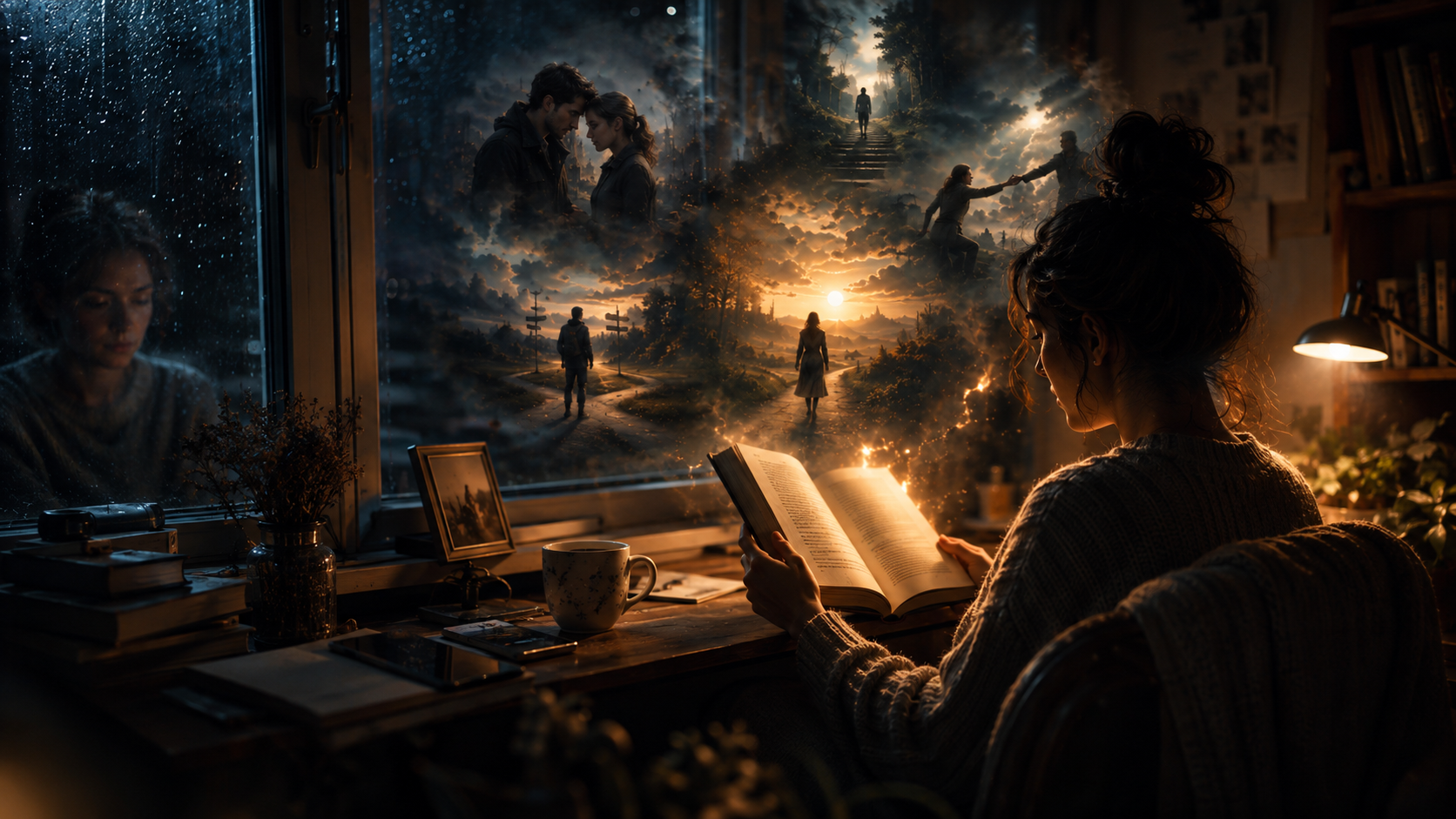
Some people choose to read before going to sleep. Others might carry around a book with them everywhere in search of quiet moments, whether between meetings, classes, or on the way back home. Reading fits differently in each person’s life, but the starting point for reading is always the same: the desire to have an escape.
If you ask people what motivates them to read fictional stories, their answers will be very straightforward: “It allows me to escape from everything else.” Indeed, life is hectic, and there are always some things that need to be done and some goals to be achieved. Stories allow people to detach from daily obligations and the never-ending responsibilities.
But the novels that truly stick with readers are never those that allow a person to escape reality. They show heartache, uncertainty, hard choices, and complex relationships. Maybe fiction is not the genre that allows a person to escape from reality, but helps them understand it better.
Do We Really Read Fiction to Escape Reality?
The obvious response is yes. Our lives are full of noise; our phones buzz, the news shows don’t cease, and we bring our commitments and responsibilities into each new day. We allow ourselves the permission to get away from it all when we open up a book, if only for an hour.
There is comfort in that brief respite. The novel requires just one thing: our attention. It slows down the pace of the day and takes all the distractions and replaces them with one voice, one setting, and one developing story. In a time when we feel like our lives are going by too fast, this simple act can be a much-needed rest.
But if escape were the only reason we read, we would probably choose easier stories. Why read books which left us heartbroken, kept us tossing and turning at night, or worried about characters that never existed? Why not pick a book that entertained us but asked for nothing further?
Perhaps escaping is simply the beginning, the enticement, and the true reason why we stay has something to do with being led back into life. Then, somewhere between the first page and the last, the story begins leading us back towards life. We return with a little more patience and a different way of seeing things.
The Stories We Remember Usually Reflect Something We’ve Lived
We may forget more novels than we actually remember. Plot gets forgotten. Minor characters fade into oblivion. Even the ending of some novels may be forgotten. However, there is always that one novel that will stick around in the memory forever. Years later, one quote or one particular scene from a novel will pop up clear as ever.
What stays with us is not always the biggest twist or the most dramatic moment. It is more often the small things that get embedded into our minds. A conversation that sounds like one we have had ourselves. A goodbye that brings someone back to mind. A fear we never admitted, finally written down by someone else.
Fiction does not create completely new emotions. It only gives expression to those that are already there in us. Suddenly, some character in the book seems to understand what we could not put into words. It seems too familiar despite the fact that the author of the book knows nothing about us.
Perhaps that is why certain books seem to find us at exactly the right time. We do not remember them because they distracted us from our lives. We remember them because they helped us make sense of something we were already carrying, even when we had not yet found the words for it.
Why Do We Care So Much About People Who Never Existed?
It is strange when you really think about it. We know fictional characters are not real. We know someone created them, chose their words, and decided what would happen to them. Still, we celebrate their victories, worry about their choices, and sometimes feel genuinely sad when their story ends.
We tell ourselves we will read one more chapter because we need to know they are safe. We get angry when someone betrays them. We feel relieved when things finally go their way. By the last page, saying goodbye can feel surprisingly close to leaving a real person behind.
It has little to do with whether a character exists. What matters is whether they feel honest. We recognise the pause before a difficult decision, the fear of losing someone, or the relief of finally being understood. Those feelings are not fictional. We have known them in our own lives.
That is also why perfect characters are often forgettable. We connect with the ones who make mistakes, doubt themselves, and keep going anyway. They do not need to live like us for us to understand them. They simply need to feel human enough for us to care.
Good Fiction Doesn’t Give Us Answers. It Gives Us Better Questions.
Some books end when we turn the final page. The story is finished, everything is explained, and we move on. Other books stay open in the mind. Days later, we are still thinking about one choice, one conversation, or one ending that did not settle as neatly as we expected.
Those stories leave us asking questions. Would I have done the same thing? Could I have forgiven that person? What would I have held onto if everything familiar had disappeared? There may be no perfect answer, but the questions stay because they feel closer to real life than certainty ever does.
They often return at ordinary times. While making dinner. During a quiet walk. Halfway through a conversation with someone we love. The book is no longer in our hands, but something from it is still working on us, asking us to look at our own choices more carefully.
Good fiction does not need to hand us a lesson. In fact, the best stories often trust us enough not to. They simply place us beside someone facing a difficult moment and let us wonder what we would do. Sometimes one honest question stays with us longer than any tidy answer.
Maybe Reading Has Never Been About Escape
Maybe we have been asking the wrong question all along. Instead of asking whether fiction helps us escape reality, perhaps we should ask what it sends us back with. The stories that stay with us rarely encourage us to turn away from life. More often, they help us return with clearer eyes.
We close a novel carrying something we did not have before. It may be a new way of seeing another person. It may be more patience for a struggle we once judged too quickly. Sometimes it is only the quiet reminder that hope can survive even when nothing feels certain.
Nothing changes overnight. The same responsibilities are still waiting. The same conversations still need to happen. Yet something inside us may have shifted, even slightly. A story has given us enough distance to look again, and sometimes that is all we need to understand something differently.
Maybe that is why we keep coming back to fiction. Not because we want to disappear from life, but because stories help us return to it a little softer, a little wiser, and more willing to see the world through someone else’s eyes.
Final Reflection
The book is closed. Your tea has gone cold. The room is exactly as you left it, and tomorrow is still waiting with all the usual responsibilities. Nothing outside you has changed. The same chair, the same window, and the same unanswered messages are still there.
And yet, something feels different. Perhaps you understand a feeling you could not name before. Perhaps you are still thinking about a choice one character made. The story may be over, but part of it has followed you back into your own life.
Maybe that is why we read fiction after all. Not to leave reality behind, but to return to it with a little more understanding than we had before. The best stories do not change the world around us. They quietly change the way we move through it.