
In allegorical novels, there are two stories. The first one is the story that appears in the pages, which can be a journey, a fight, an escape, or a quest. But there is also a deeper tale that deals with some larger idea like religion, authority, freedom, salvation, or human nature.
There may be a traveler who makes a perilous voyage. At the same time, his voyage symbolizes grief or spiritual transformation. A leader may be made to illustrate the consequences of uncontrolled authority.
As mentioned by The Poetry Foundation, allegory is an extended metaphor where people, places, and objects stand for some other meanings. One single symbolic element cannot make an entire novel an allegorical one.
What Makes a Story Allegorical?
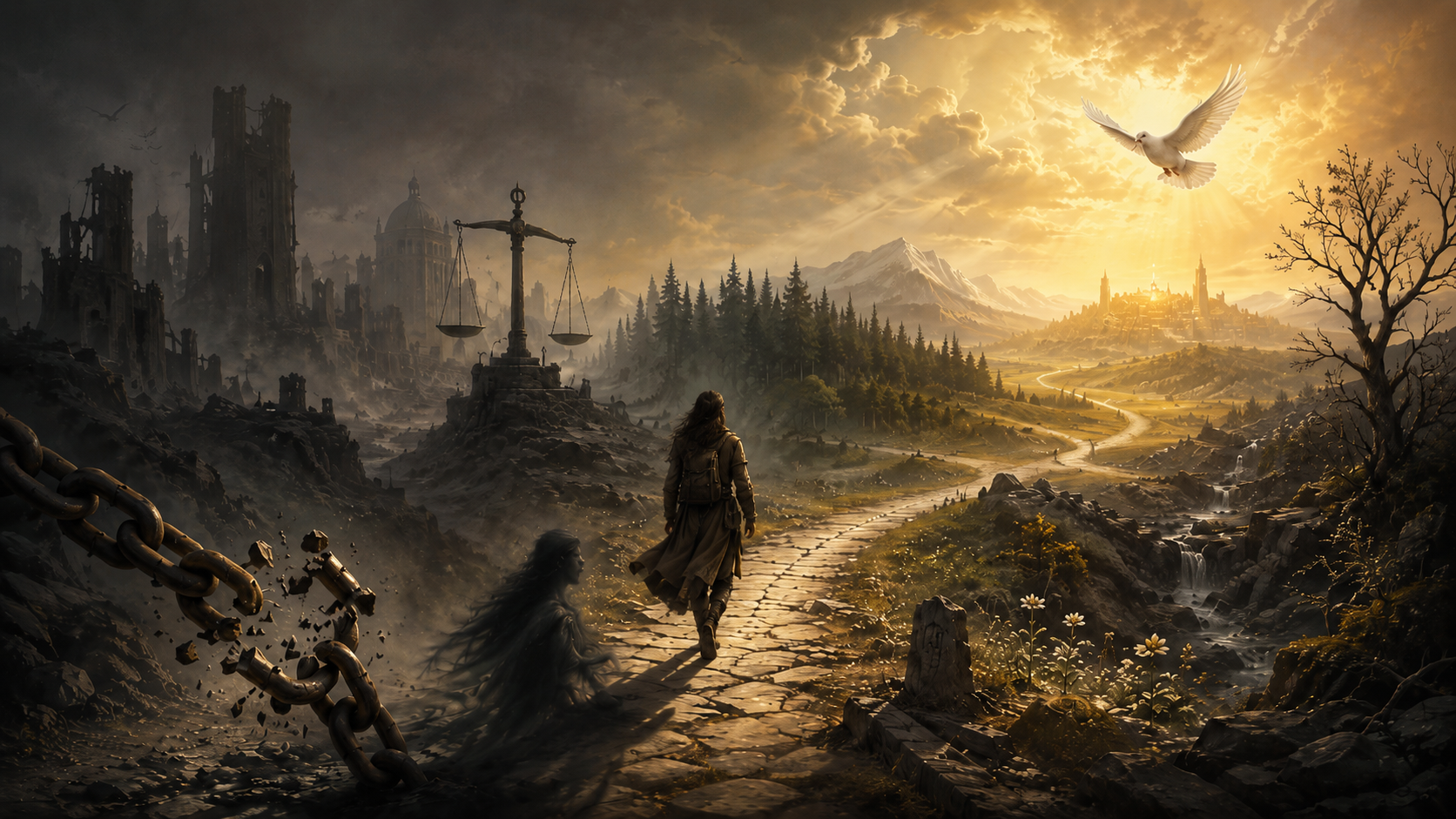
For instance, imagine a white bird might fly into view in the aftermath of a character’s great loss. The bird would symbolize peace, hope, and freedom. This is symbolism; however, it will not make the story an allegory by default.
Allegories consist of many elements that work together to create the story. Setting, characters, conflict, journey, symbols, and ending may all hint at the same message, be it moral, political, religious, or sociological.
One can tell right away whether the story is allegorical by asking three questions:
- Is the underlying plot reasonable enough on its own?
- Do several elements hint at the same underlying message?
- Does that second message help understand the story better?
For instance, a traveler leaves the ruined city, passes through the dark forest, succumbs to temptations, and arrives in a land full of light. This story may serve as an adventure; however, it can also stand for a man’s progress through darkness and despair.
Not every detail needs one fixed meaning. The forest could suggest fear, confusion, or danger. Some allegories are clear. Others leave more room for readers. The Oregon State University guide to allegory also notes that readers help shape interpretation.
How Do the Two Levels Work Together?
The surface story is what physically happens. Someone leaves home, breaks a law, fights an enemy, loses something, or searches for a missing person. The second level asks what those events may mean beyond the plot.
A journey could explore faith. A controlled city might raise questions about freedom. A lost home may stand for innocence, identity, or a past that cannot be recovered. A strong allegory needs both levels. The plot gives readers people to care about and problems to follow.
The deeper meaning gives those events more weight. A character’s fear still needs to feel real. A sacrifice must matter emotionally before readers ask what it represents. The story comes first. The meaning grows through it.
Allegory, Symbolism, Metaphor, Fable, and Parable
These terms are related, but they are not the same.
| Device | Simple meaning | Example |
| Symbolism | One object, image, or action suggests a larger idea | A broken chain represents freedom |
| Metaphor | One thing is described as another | “Grief is a heavy coat” |
| Allegory | A full story carries a connected second meaning | A journey represents spiritual growth |
| Fable | A short moral story, often using animals | Proud animals learn the cost of vanity |
| Parable | A short story that teaches a moral or spiritual lesson | A stranger’s kindness teaches mercy |
The Poetry Foundation explains that a physical object can point towards an abstract idea.
A metaphor is usually smaller. It compares one thing with another. Allegory carries that kind of comparison across a whole narrative.
Fables and parables can be allegorical, but they are usually shorter and more direct. A full allegorical novel may take longer to reveal its meaning, and readers may disagree about parts of it.
Why Do Writers Use Allegory?
Ideas such as guilt, corruption, faith, and redemption cannot be physically seen. Allegory gives them shape.
Corruption may appear through a leader who slowly changes the rules. Fear might become a place no one wants to enter. Guilt can feel like a burden a character carries. Redemption may appear as a return home or a movement from darkness into light.
Rather than saying that power corrupts, a writer can show a trusted leader becoming controlling. We watch promises change, rules bend, and silence spread.
Allegory also gives readers a role. A direct argument tells us what the writer thinks. An allegorical story asks us to notice connections and decide what they mean.
How Can Allegory Explore Faith?
Faith is often shown through movement because belief itself cannot be seen. A road may represent spiritual growth. A difficult crossing may show doubt. A wrong turn can stand for temptation. The destination may suggest peace, truth, or salvation.
John Bunyan’s The Pilgrim’s Progress, first published in 1678, is a famous example. It follows Christian as he travels from the City of Destruction towards the Celestial City. His journey is physical, but it also explores sin, faith, temptation, and salvation. The text is available through Project Gutenberg.
A modern story may explore faith through sacrifice, forgiveness, doubt, or the search for meaning after loss.
How Does Allegory Show Power?
Political power can feel distant when it is explained through theories and dates. Allegory brings it down to a human level.
A ruler changes one law, then another. A trusted leader begins controlling information. People accept small injustices because speaking out feels dangerous. The story shows how power grows and how freedom can disappear slowly.
George Orwell’s Animal Farm is a well-known example. On the surface, farm animals rebel against their human owner and try to build a fairer society. Beneath that story is an allegory about the Russian Revolution, Soviet rule, and the corruption of revolutionary promises. The Orwell Foundation explains this political context.
The farm is fictional. The pattern of power is not.
How Does Allegory Explore Redemption and Human Nature?
Redemption often appears through change. A character may return home, admit the truth, remove a burden, repair past damage, or choose mercy over revenge. These events happen in the plot, but they can also show inner change.
Allegory can also place human qualities under pressure. Greed, pride, fear, loyalty, love, and mercy may appear through characters or conflicts.
This does not always create a simple lesson. A person can be loving and selfish, brave and frightened. The strongest allegories allow both light and darkness to exist within the same character. What matters is what they choose when they are tested.
Can an Allegory Have More Than One Meaning?
Yes. Some of the allegories have definite correspondences between characters and symbols. Other allegories are more implicit. A trip through the desert may mean grief to one person and a crisis of faith to another. Both interpretations are possible if the plot, symbolism, language, and resolution justify them.
Readers also provide their own experiences and beliefs, which is the reason why the same piece can be interpreted differently by different readers. However, not all interpretations are equal in their validity. The interpretation requires evidence. Try to find out whether the symbol is used repeatedly, related to the main conflict, and contributes to its resolution.
How Can You Recognize Allegorical Fiction?
Think about patterns, not every object having an encoded meaning. Characters may have names and functions corresponding to some broader concepts. The journey may correspond to emotional or spiritual transformation. The setting may feel like a miniature of society. Light-darkness, freedom-restriction, remembrance-forgetting may be contrasting the whole story.
Even the conclusion is important. Allegorical stories tend to solve not only the story problem but also the underlying problem. The use of fire once in the narrative may mean nothing. However, if it shows up repeatedly in connection with destruction, revelation, cleansing, and rebirth, it may mean more than that.
Not only should you wonder, “What does this object represent?” You should also think about the following question, “How does this allegorical interpretation help me better understand the story as a whole?”
Final Understanding
Allegorical fiction offers readers a good story along with an examination of some broader issue. A journey becomes a quest for faith. The leader reveals the nature of power. A character who comes out of darkness becomes the hero who has been redeemed.
This happens because allegories translate abstract ideas into life experiences. Instead of learning what the writer says about fear, corruption, mercy, and hope, readers witness how these concepts affect characters and what results from their actions. Reading an allegory is not about discovering the one true meaning hidden behind every phrase. It is about recognizing the moment when all the elements start pointing in the same direction. The plot tells us what happened. The allegory asks what it means.