

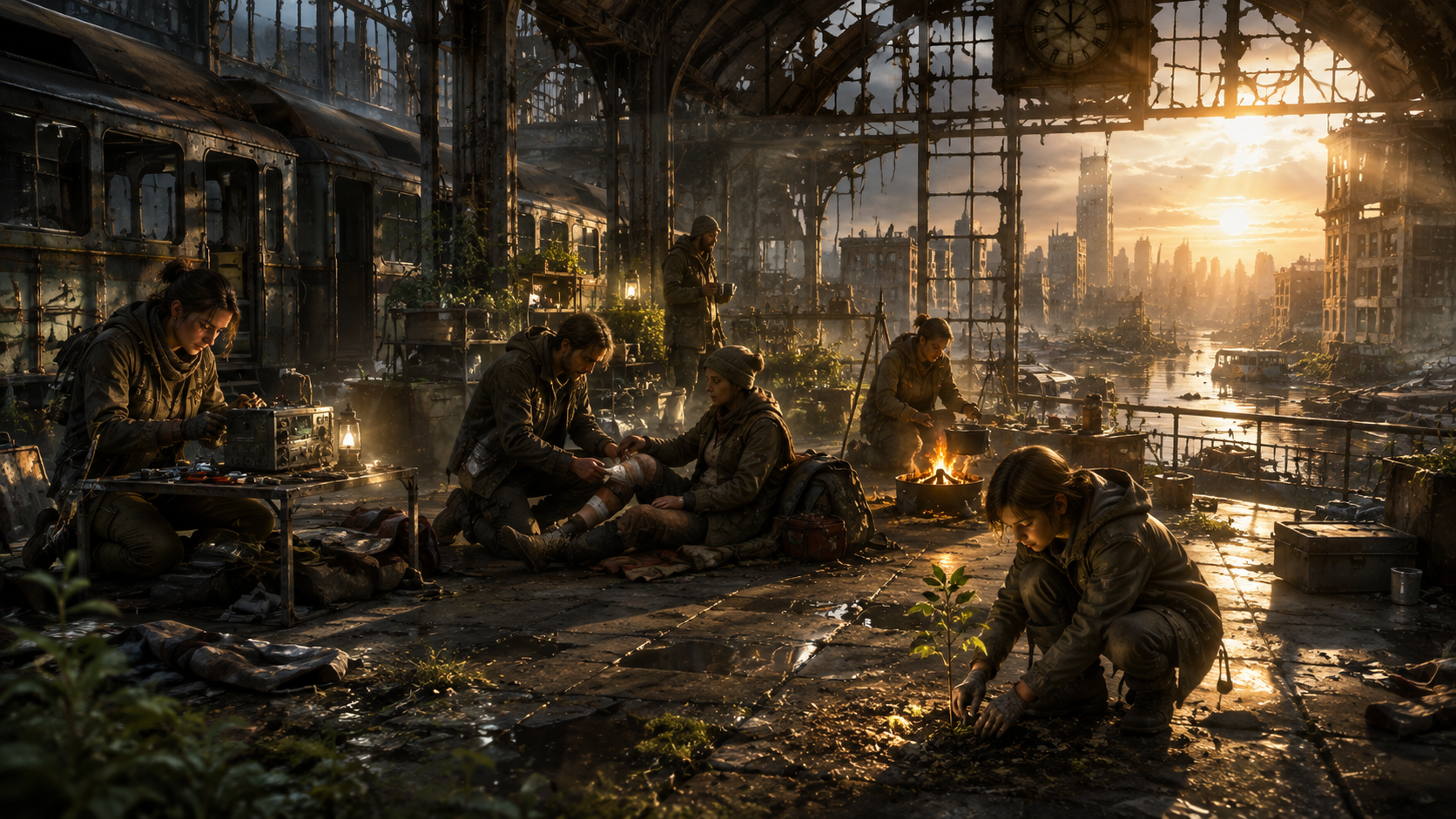
Post-apocalyptic fiction shows us a world after something has gone terribly wrong. It may be a war, plague, climate crisis, malfunctioning technology, or even some kind of event that people do not understand completely. The roads are deserted. Governments cease functioning. It becomes impossible to obtain food, medicines, and reliable information.
But the catastrophe is just the beginning. It is actually what people decide to do after it that counts. Whom will they trust? Will they come to the aid of strangers during the shortage of supplies? What leads one group to cohesion and another to dissolution? And when everything people were accustomed to has ceased to exist, what motivates them to go on?
Fortunately, psychology provides many relevant answers. The fear, leadership, group dynamics, and search for hope depicted in these books seem rather close to reality.
What Is Post-Apocalyptic Fiction?
Apocalyptic fiction deals with the disaster while it is taking place. Post-apocalyptic fiction is devoted to its aftermath. It is not quite the same as dystopian fiction. A dystopian story centres on an unfair or controlling society. A post-apocalyptic story begins after a major collapse. The two can overlap, especially when survivors build a new society that later becomes oppressive.
Oxford Research Encyclopedia of Literature notes that an apocalyptic narrative may involve both destruction and its aftermath. Once all old structures are removed from the plot, it gains space for raising a hard question about what people will build in their wake.
What Psychology Says About These Narratives?
While authors do not design their works based on specific psychological theories, the same theories are always recurring in their works.
| Theory | Main idea | How it appears in fiction |
| Narrative simulation | Stories let us explore danger from a safe distance | Readers imagine who they would trust, help, follow, or leave |
| Terror management theory | Thoughts of death can make people hold tighter to beliefs and identity | Characters turn to faith, family, tradition, or ideology |
| Meaning maintenance model | People search for order when life stops making sense | Survivors create routines, rules, goals, and explanations |
| Social identity approach | Shared danger can create a stronger sense of “us” | Strangers begin working together as one group |
| Hope theory | Hope needs a goal and a possible route towards it | Characters change their plans when the first one fails |
These ideas do not explain every story. They do help us see why the genre returns so often to trust, death, community, leadership, and hope.
Why Do We Want to Imagine the Worst?
Post-apocalyptic stories let us think about frightening situations without being in real danger. Psychologists Raymond Mar and Keith Oatley have described fiction as a simulation of social experience. We watch people make choices, deal with others, and face the results. We feel some of the pressure, but we are still safe.
Would you share your last meal? Trust a stranger who appeared after dark? Follow a strict leader who promised shelter? Leave one person behind to protect everyone else? A story gives us time to sit with those questions.
This may be why so many post-apocalyptic novels follow small groups. Every relationship becomes visible. One person lies. Another takes charge. Someone has a skill the group needs. Someone else is treated as a burden. The world may be fictional. The behaviour is not.
Why Is Meaning So Important in a Post-Apocalyptic World Full of Death?
Terror management theory starts from a simple idea: people want to live, yet they know there is nothing they can do to avoid their death. In early studies of terror management theory, it was shown that reminders of one’s death may lead to the need to protect one’s values and identity.
A post-apocalyptic world is filled with reminders of death; people have lost homes, families, communities, and any guarantee that tomorrow will come. As a result, many of them try to hold on to anything that gives their life meaning. This may be a belief in God, caring for children, fulfilling a promise, preserving information or sticking to their moral values.
Others turn towards harsh beliefs because certainty feels safer than admitting they are lost. The meaning maintenance model sees this from a different angle. It states that people look for new patterns when their world starts losing its meaning.
That is why survivors try to mark the passage of time by writing days on walls, repeating rituals, telling stories, creating rules, or choosing some place to move to. None of those actions removes the threat but gives some shape to life.
Are Catastrophes Inevitably Turning People into Selfish Beings?
Many books about disasters show how quickly and thoroughly society breaks. Stores are attacked. Strangers are seen as enemies. Everyone takes care of their own interest. Reality is much more complex than fiction. In the study of survivors from several emergencies, psychologists John Drury et al discovered that shared danger may produce a bond among people.
Those people who saw themselves as a community were helping and supporting each other. There is even a name for such behavior in science. The researchers call it catastrophe compassion. People share their food. They provide shelter for others. They save strangers and organize help in the local area. Of course, conflicts happen too.
Fear, rumors, lack of resources, and discrimination may divide people. But selfish panic is not the only natural response. Panic theory holds that scared people should be regarded as individuals fighting to survive. According to the social identity theory, being faced with similar threats will result in individuals regarding themselves as belonging to one group.
The best examples of post-apocalyptic literature contain both theories. Individuals could love people belonging to the same group but become wary of all those from other groups.
Why Is It Important To Trust As Much As Eating?
An individual could have all the provisions needed but be in danger if he/she receives incorrect information. Is the water safe? Does the road really lead to shelter? Is help coming? Can the person at the gate be trusted? In these stories, trust becomes another survival resource. Characters cannot check every claim for themselves.
They must decide whose knowledge matters and who has earned the right to lead. Uncertainty can also affect the kind of leader people choose. Research on uncertainty and dominant leadership suggests that people may be more drawn to forceful leaders when they feel frightened or unsure. Post-apocalyptic stories use this pattern often.
A leader offers food, shelter, and order. At first, the rules seem fair. Later, questions are discouraged. Supplies become a way to control people. Safety starts to come with conditions. A strong leader is not simply someone who gives orders. The real test is whether people can question decisions, hear the truth, and hold that leader responsible.
Why Is the Lone Survivor Often a Myth?
The lone survivor makes a dramatic character. One skilled person hunts, builds shelter, repairs tools, and keeps away from everyone else. Real survival is usually far more social. One person understands medicine. Another knows how to grow food. Someone can fix equipment.
Others organize supplies, care for children, remember useful information, or notice dangers the rest have missed. Research on social identity and collective resilience shows that a shared sense of belonging can help people cooperate during difficult situations. That does not mean every community is fair.
Groups may exclude outsiders, silence weaker members, or divide resources badly. So the better question is not whether people need a community. It is what kind of community they are building.
Is Hope an Emotion or a Survival Skill?
Hope is often treated as the belief that everything will turn out well. Psychologist C. R. Snyder described it more practically. His hope theory has two main parts. Agency is the drive to keep moving towards a goal. Pathways are the possible routes for reaching it. This fits post-apocalyptic fiction well.
A hopeful character does not need to feel cheerful. They need something to work towards and one possible next move. Find shelter. Reach another town. Protect someone. Plant food. Save a book. Teach a child. Then the plan fails. They look for another way.
In Station Eleven, art, memory, and human connection remain important after a pandemic because staying alive is not enough by itself. The National Endowment for the Arts looks at how the novel treats culture and community as part of survival. Hope does not always mean waiting for the old world to return. Sometimes it means trying to make the new one worth living in.
Why Do These Stories Still Feel Relevant?
Post-apocalyptic fiction changes with the fears of each period. Nuclear war, pandemics, climate damage, political violence, and dangerous technology have all shaped the genre. These stories are not exact predictions. They do something else. They turn huge fears into human choices. We see trust break down and slowly return.
We notice how inequality affects who receives safety. We compare leaders who serve people with those who use fear to control them. We also see what people save when saving everything is impossible. That is why these stories can feel frightening and hopeful at the same time. They show us what could be lost. Then they ask what might remain.
Final Thoughts
Post-apocalyptic fiction may begin with ruined cities and empty roads, but its deeper concern is people. What happens when their old answers no longer work? Psychology shows that a crisis does not always lead to panic or selfishness. Shared danger can bring strangers together. People can rebuild meaning through routines, beliefs, relationships, and goals. They can also keep hoping without knowing how things will end. The genre stays relevant because it asks more than whether people can survive a disaster. It asks whether they can trust, care, organize, and rebuild together and what could make that new life worth living.